
 http://www.living.co.za
Monday, May 28, 2007

Saturday, May 12, 2007
Newsletter - May 2007
Dear Friend in Wine

The days are growing shorter, vineyards are turning colour, days are perfectly warm – it’s Autumn in the Cape. And harvest at Vergenoegd is behind us for another year.
We experienced favourable conditions during the growing season leading up to harvest, which was slightly earlier and smaller than our previous vintage. Even though we experienced some extremely hot days in the Cape, it was on average a cooler season. Very welcome rain followed the hot spell to assist ripening without too much stress.
PROMISING VINTAGE
The Merlot and Shiraz look very promising. I expect more concentration in the Cabernet Sauvignon as a result of the smaller harvest, which will result in a well-structured powerful wine. French Oak Barrels will then help soften the tannins
FIRST PICKINGS
We picked our first crop of Malbec at Vergenoegd this year and early indications are that it will produce a softer elegant wine that could play a complementary role in future Terrace Bay blends.
Our newer Cabernet Franc block, which has just delivered a second crop of grapes, looks very impressive. I predict that these grapes will play a major role in the Terrace Bay and Vergenoegd Estate blends. I might even be tempted to produce an individually bottled cabernet Franc varietal. Cabernet Franc wine!
WELCOME RAIN
A welcome spell of rain the day after harvest was just what the doctor ordered for our vines. These rains offer weary and tired vines some revitalization and set in motion the production of reserves within the vine itself. This wonderful process of nature ensures that the plant’s reserves are now transported into the root for winter, instead of feeding the grapes they have been supporting during summer.
POMEGRANATE RESTAURANT AT VERGENOEGD
Mike Israel continues to make inroads into the Cape Food Society. He is winning compliments for his superb dishes, as well as for his incredible knowledge when it comes to food and wine pairing. Mike and his chef Siraaj Allie have come up with some exciting new dishes for the winter season.
My favorite at the moment is the Deboned Duck Breast seared then cut into medallions, mounted around mash potato and baby vegetables. Using the stock from these ducks, a fine consommé is produced and used as dressing. Finished with a Duck Rilette, perfectly paired with Vergenoegd Merlot
The restaurant is well worth a visit - you can use the Vergenoegd telephone number to make your booking.
WINEMAKER’S RESPITE
A winemaker need a week’s break to recover from an arduous harvest of late nights and busy days, so that we too can come back refreshed, replenished and energized. Unfortunately, unlike the vines, we do not have the luxury of a whole winter’s break!
Start preparing for the indoor fires, thinking of slow food cooking and get that bottle of favourite VERGENOEGD ready to drink and enjoy along with that meal in front of the fire.
Sincerely
John Faure
Wednesday, February 28, 2007

Our History

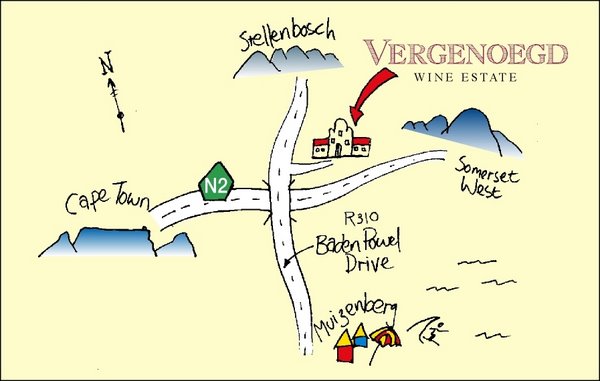
Vergenoegd (which literally means ‘satisfaction has been achieved’ in Dutch) was originally granted in 1696 to Pieter de Vos, who must have felt that he had “achieved satisfaction” a short distance from the port city of Cape Town. The view from the homestead today towards Table Mountain in the west remains almost unaltered. The farm is virtually on the shores of False Bay and is overlooked by the impressive Hottentots Holland Mountains. One of the three great wine estates of the False Bay area, Vergenoegd is close to Stellenbosch, Somerset West and Cape Town.
The homestead, with its beautiful “holbol” gable, has become the well-known trademark of the Estate. It was built by one of the previous owners, Johannes Colyn. Dated 1773, it bears the name “Vergenoegt” - incorrectly spelt. Plasterwork on the side of the Manor House and the original slave bell are examples of the functional building traditions of Europe made uniquely Cape by early tradesman.
Johannes Gysbertus Faure took ownership of the Estate in 1820, by which time wine had been made there for fifty years. Johannes Albertus Faure, who was a member of the Cape Legislative Council, bred racehorses on the Estate and his brother Sir Peter Faure was also a politician and a friend of Cecil John Rhodes.
Winemaking has been an integral part of the Estate during its whole existence. The natural flor yeasts used in the making of Sherry were found on Vergenoegd by Dr Charles Niehaus in 1936 and shortly afterwards Vergenoegd was producing sherry for the KWV. It was Dr Niehaus who persuaded the Faures to plant Cabernet Sauvignon. The Vergenoegd Cabernet Sauvignon made its name on the National Red Wine Show five times as Champion and four times as Grand Champion wine. This success has continued through the years until today with all the Vergenoegd wines consistently being awarded excellent star ratings in both the John Platter South African Wine Guide and the authoritative Wine Magazine tastings.
the Vergenoegd philosophy
There is a single-mindedness in this partnership to build on the Vergenoegd tradition of excellence and to continue to make quality red wines that age well, from only the best grapes.
The wines are made with modern and attentive vineyard management, a minimalist approach to irrigation, selective harvesting and non-invasive vinification. They are then aged in mainly French oak barrels for 16 to 20 months and are further aged in bottle for one year before release.
The process of wine-making at Vergenoegd strives to achieve a unique Vergenoegd character. A wine that has balance, elegance, complexity and fruit: a wine that complements fine dining and good food - to be enjoyed at about three years of age, but that will continue to improve and mature over the next few years, keeping its peak till at least 10 years or longer.
Unique terroir
Vergenoegd’s soil profile varies from alluvial loam to sand with yellow clay and calcareous layers, probably of marine origin. The soils, together with the cool maritime climate, as a result of the prevailing sea breezes from the nearby False Bay coast, give Vergenoegd a unique and interesting terroir. This terroir has proven over the years to be suited to producing full bodied, rich red wines with a distinctive mineral quality.


Subscribe to:
Posts (Atom)